Countdown to London

“As a foreigner in London, I like that there are so many other foreigners.”
David Sedaris

How lucky are AAC CPA and I?

For the 3rd time this year, we’re on our way to London. This trip came about thanks to a blog entry by The Points Guy a few months ago giving us the skivvy that fares were being slashed to Europe over the holidays. If you happened to be an AARP member (reminder: you don’t need to be 50 to join AARP, just sayin’) and, for instance, went through the AARP website to a dedicated British Airways link, you automatically got a $400 per person discount. Added to that, we cashed in some Avios miles to save even more money.

How could we not go?

TRAVEL TIP: The Points Guy

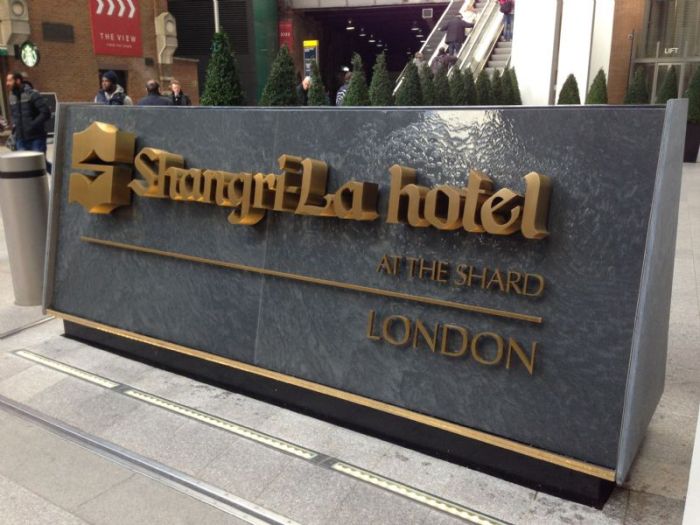
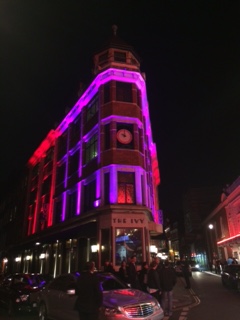
In the event, we’re leaving early Sunday morning, will arrive early evening local time, Heathrow Express our way into central London and be at the Shangri-La at the Shard in time for a late supper with our friends A & K, who will have arrived the day before. As I said, how lucky are we?

We also got lucky with a special promotion through the AmEx FHR program. Although we’d already booked a return visit to the Shangri-La, it turns out that, thanks to AmEx, you can pay for 2 nights and get the 3rd for free. Our awesome AmEx travel agent, Veronica, was happy to rebook the reservation so that we could take advantage of this offer. The only fly in the ointment is that we’re planning to be in London for 6 nights, and the hotel refused to let us use the promotion twice on this visit. Other hotels do it all the time but not the Shangri-La. Good thing it’s a really nice hotel or we’d be very miffed. (Well, maybe we are, just a wee bit.)

Shangri-LaTime for a return visit to the Shangri-La

TRAVEL TIP: AmEx FHR Program

TRAVEL TIP: Once you’ve booked your hotel reservation(s), go back every so often either to the hotel’s website or the AmEx FHR website and check for better deals. I’d say that there’s an excellent chance that you’ll find a lower rate or, even, a promotion like the one we’re taking advantage of next week. If you have the forbearance (and the time, of course), you may end up saving significantly on your hotel bill.

“In London they don’t like you if you’re still alive.”
Harvey Fierstein

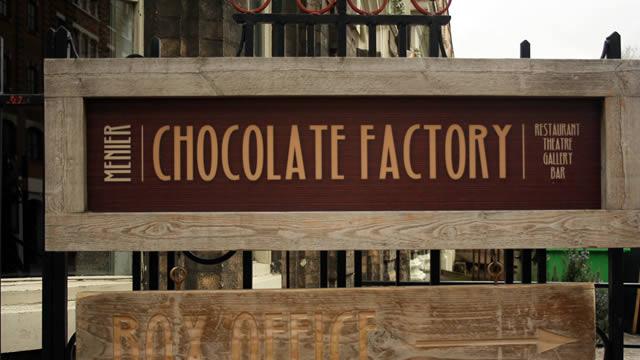
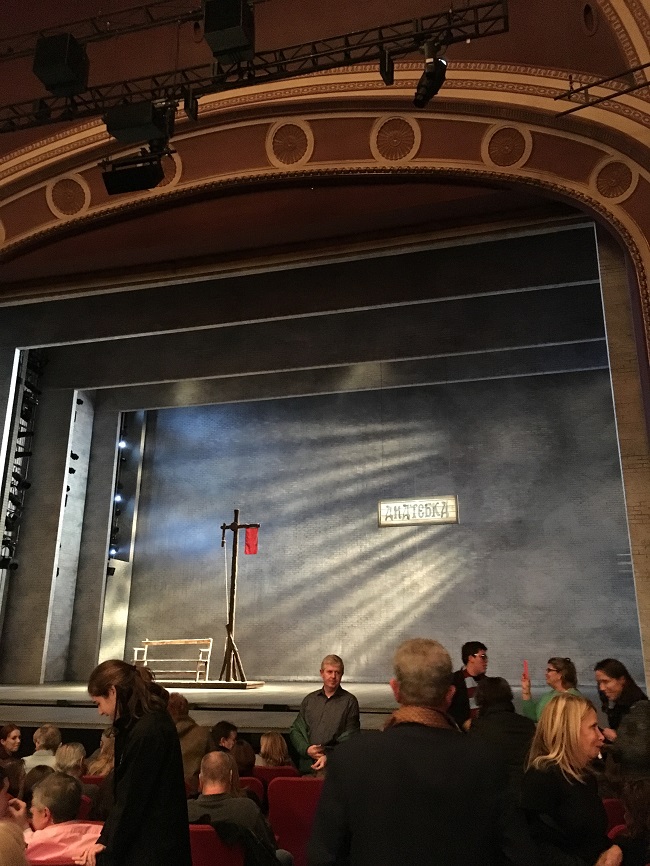
Before we pulled the trigger on the airfare deal, I checked to see if we could score tickets to, arguably, the biggest theatre deal in London this fall: the revival of Funny Girl at the Menier Chocolate Factory. At the time, I went to the theatre’s website to check on availability and found that tickets didn’t go on sale to the general public until the following day. Call it my cultural sixth sense, but I decided that I had to get tickets right then so, for a modest donation to the Chocolate Factory, I was able to select prime seats (well, in a 188-seat theatre, I guess that ALL seats are prime), for a little more than tuppence. Having taken care of that task, we went ahead and booked the air tickets. Thank you, AARP; thank you, British Airways; thank you, Avios miles. (And thank you, Chocolate Factory!)

And, wouldn’t you know, when general public seating opened the following day, the entire engagement sold out within 2 hours!! The Chocolate Factory had never seen anything like it. Ever!!

So even if you can’t obtain tickets at the Chocolate Factory to see the show, don’t despair – before it even started previews, a transfer to the West End was announced! And, if you’ve never been to the Chocolate Factory, you really should pay a call. It’s a great space and some amazing productions have started there.

Chocolate Factory

CULTURE TIP: Menier Chocolate Factory

CULTURE TIP: Funny Girl at the Savoy

“London is too full of fogs and serious people. Whether the fogs produce the serious people, or whether the serious people produce the fogs, I don’t know.”
Oscar Wilde

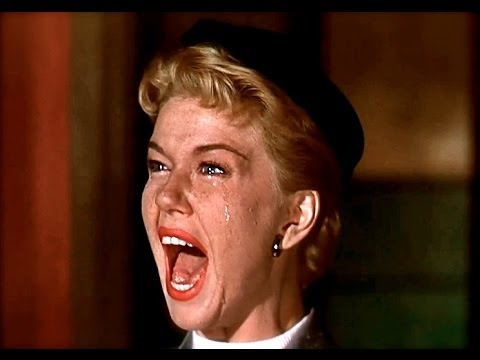
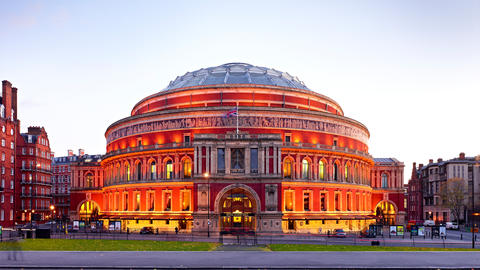
As usual with our visits to London – I believe that this will be our 14th time there – we tend to book up heavily on the cultural side of things. This visit is no exception: 3 shows on the West End, the aforementioned FG at the Chocolate Factory, our first ever Panto (Cinderella at the Hammersmith), and another venue new to us: a Candlelight Christmas Eve Concert at the Royal Albert Hall. (AAC CPA has promised not to scream at the climactic part of the concert a la Doris Day in Hitchcock’s The Man Who Knew Too Much.)

Doris Day
Doris Day or AAC CPA? You be the judge.

Albert Hall
The Royal Albert Hall

“London is a roost for every bird.”
Benjamin Disraeli

In between all the culture, there’s the eating. We’ve booked some fun meals at some of our old haunts, and I’ll be reporting on them as merrily we roll along. We’ve also been invited to join A & K for a holiday dinner with A’s family, as they reside in Merry Olde. We’re very flattered to be part of their family for that special evening.

The other fun thing is that, on Christmas Night in London, the very final episode of Downton Abbey will be telecast and we’ll be there to see it. (Don’t tell anyone, but we’ve already seen the final season and it’s GOOD! Shhhhhhhh!) We’re a bit sorry to see the series go, but it seems to be ending on a high note.

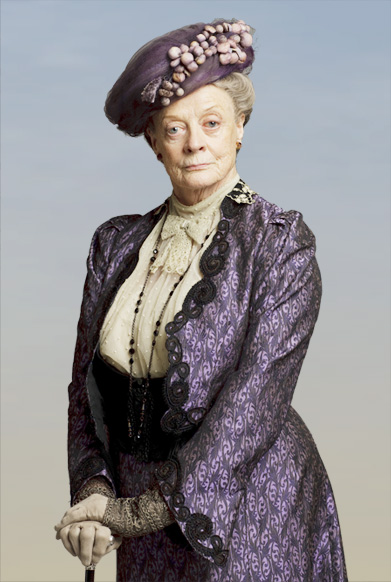
Violet, Dowager Countess of Grantham
What would Violet, Dowager Countess of Grantham say?

I’ll try to post a couple of entries while we’re across the pond to let you know how it’s going.

In the meantime, I hope that all of you are enjoying a happy and healthy holiday season.

Cheers!


Carol and A Wee Bit of History

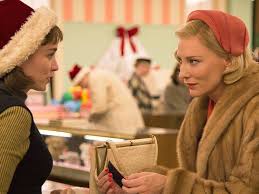
In 1952, Patricia Highsmith (best known as the author of Strangers on a Train and The Talented Mr. Ripley) wrote the romance novel, The Price of Salt, under the pseudonym of Claire Morgan. Over 60 years later, director Todd Haynes (Safe, Velvet Goldmine and Far From Heaven) and screenwriter Phyllis Nagy (Mrs. Harris) have adapted the novel into the film Carol, starring the regal Cate Blanchett and the gamine Mara Rooney. Taking place in the early 1950s, at the dawn of the Eisenhower administration and the ensuing conservative era – in which the “norm” was white picket fences, moms and dads with 2.1 children, and Leave It to Beaver – the film never could never have been made back then.

Carol traces the meeting and ensuing relationship between Carol Aird (Blanchett), an upper middle class New Jersey housewife in the midst of getting a divorce from her very whitebread husband, Harge (Kyle Chandler, continuing his move into non-sympathetic characters), and Therese Belivet (Rooney), a younger aspiring photographer relegated to working behind the doll counter at a New York department store.

What interests me about this movie is two-fold.

First, Haynes makes extraordinary films and is a highly disciplined filmmaker. His major release breakthrough film, 2002’s Far From Heaven, faithfully channeled the 1950s films of Douglas Sirk (Magnificent Obsession, Written on the Wind, Imitation of Life), which were at the time referred to as “woman’s films”. In Far From Heaven, Haynes was meticulous in recreating the era in which the film took place. Filmed in exploding autumnal tones, every element of story, performances and production design contributed to the audience’s experience.

In Carol, Haynes has done himself one better. Against a completely different color palette, but with no compromise in period details, the story unfolds as a flashback, and is bookended by a scene that both opens and closes the film. Without giving anything away, the scene as first presented seems like a throwaway. But, when it is repeated at the end of the film – and shot from different angles – the scene takes on much more weight and emotion. It is the cherry on top of a delicious sundae.

Much has been made of the performances of Blanchett and Rooney, both of whom are completely invested in the material and in each of their character’s emotional journeys. Neither of these extremely talented actors holds anything back. There is no winking at the camera; Blanchett and Mara play for keeps and the audience benefits immensely.

Carol
Mara Rooney and Cate Blanchett in Carol

The other point of interest for me is that, as I’ve already said, this film never would have been made in the 1950s. The American zeitgeist at that time simply wasn’t ready to accept or even understand this story. (As Carol says to Therese early in the film, “You’re flung from outer space” – which is how this movie and its lead characters would have been received: as aliens.) Ang Lee’s 2005 masterpiece, Brokeback Mountain, was met with much snickering and discomfort by segments of its audience, proving that even 10 years ago, American audiences weren’t quite ready to accept that film on its own terms. What a difference a decade makes.

Bridging the gap between 1952 and 2015 is the extraordinary pendulum swing in the push for LGBTQ equality. In 1952, almost non-existent and, in 2015, almost – but not quite – ho-hum, due to the astounding achievements by the LGBTQ community and its straight allies. There are many factors contributing to what I believe is the most successful campaign ever for equality in the relatively shortest amount of time.

One “parent” of the movement which began at the exact midpoint between Highsmith’s book and Haynes’ film was the establishment of an organization called glaad. Founded almost exactly 30 years ago at the height of the AIDS crisis (and the unprecedented amount of media scrutiny and homophobia), glaad’s original mission was to work in tandem with the media to insure fair, accurate and inclusive coverage of lesbian and gay stories and reporting in all forms of media. (The BT and Q hadn’t yet been added in 1985.)

I had the privilege and honor of working with glaad almost since its inception and was intimately affiliated with the organization for over 20 years. As a witness to and a participant in its work on a daily level, I was able to see how it was and is possible to change hearts and minds, sometimes one at a time.

The early years were mostly about reactive tactics and were very challenging for the organization. When Bill Buckley wrote that all HIV-positive people should have their backsides tattooed as a warning to unsuspecting sexual partners, glaad turned up on his doorstep to protest. When Bob Hope referred to gays as “fags” on the Johnny Carson show, glaad called him on it and, in response, Hope made a PSA on the Tonight Show set to talk about how harmful pejorative labels can be. Back then, persuading the New York Times to use the word “gay” instead of “homosexual” was, at the time, a major victory. Those were the early years.

glaad’s work continued undiminished and, by building respectful and collegial relationships with large segments of the media, our work became more proactive. Movies and television series began highlighting more and more gay characters and storylines. Print media started telling LGBTQ stories in a more honest and straightforward (no pun intended) way. Again, it was always about fairness, accuracy and inclusion. Because of glaad’s celebrated Media Guide (a kind of road-map on ways in which the media could cover the community, whether in terms of reportage or entertainment), the media in turn would reach out to glaad, knowing that it had a valuable resource.

Then, in the fall of 1998, came the tipping point. A new NBC series premiered on September 21st: it was Will & Grace and it was a sitcom. Considered very risky at the time, it was the I Love Lucy concept, but with a twist: Will was Ricky, but gay; Grace was Lucy, his best friend (but still had red hair). The 2nd bananas (Ethel and Fred, if you will), were Will’s best gay friend, Jack, and Jack’s best gal-pal, wacky and wealthy Karen. The show was an immediate hit: new, fast, funny and totally irreverent.

It also caused a tidal wave in terms of changing the conversation regarding the LGBTQ community. What The Mary Tyler Moore Show did for single, independent women and Julia and The Jeffersons did for African-American families, Will & Grace was now doing the same thing for the gays. Because all of these shows were, first: good entertainment and second: non-threatening, they became accessible to mainstream audiences. These shows became what we called at glaad “water cooler conversation” the day following each episode. It’s what people were talking about.

More significantly, Will & Grace became a flash point for thousands of lesbians and gay men who, through the show, were able to come out their families and friends. I remember at the time the volumes of phone calls and mail glaad received regarding Will & Grace and how sons and daughters were watching the show with their parents and having open and honest discussions about who they were, and thanking glaad for, in some small measure, making it possible.

While I will not claim that glaad was responsible for each and every victory that has been hard-fought and won over the past 30 years – there are many other significant LGBT organizations that worked in other arenas (legal, political and other fronts) – I think it’s fair to say that Carol and Far From Heaven and all the other wonderful LGBTQ stories that have been told are the direct descendants of Will & Grace and, for that, I am extremely grateful and, yes, proud.

But, listen, please feel free to forget the history lesson. Instead, buy yourself a ticket to Carol and be transported to another time and place and revel in what is, arguably, one of the best films of the year. You won’t be sorry.

Here is selection of reviews of Carol:

New Yorker Review

Variety Review

New York Magazine Review

Vulture Review

New York Times Review


For more information about glaad, please visit:

glaad


Dining in Brooklyn, Opera in a Loft; and an Uber PostScript

Greetings and salutations, all. I’m looking out of my office window at a beautifully bright and sunny afternoon here in the city that never sleeps. True, it’s on the cool side, but 50 degrees in December is almost like a heat wave for us.

Just to show you how lovely my city can be this time of year, here’s a photo I took at Columbus Circle late Thursday afternoon. Pretty gorgeous, huh?

Columbus Circle

I thought I’d share with you our excursion last night to a place called Brooklyn. Do you know it? As we say on the Upper West Side of Manhattan: “It’s over there, somewhere” as we gesture vaguely in some unknown direction. Actually, Brooklyn is an amazing place where all kinds of interesting things are going on: restaurants, shops, clubs, culture. It’s all there for the taking.

So, I had heard about this ambitious young opera company: LoftOpera. The company presents their productions in unusual spaces in Brooklyn. Believe me, this is NOT your parents’ opera company. Even though they choose operas from the standard repertoire, the productions are cutting-edge, exciting, unusual and cast with up and coming singers. When was the last time you saw La Boheme in which all of the singers were age-appropriate?

And speaking of age, the average age of the Metropolitan Opera audience is about 57+ (according to a sampling of 15,750 audience members taken in 2005). That makes AAC CPA and I relative youngsters when we go to the Met. Just looking around the audience at LoftOpera last night, call us Gramps, as the place was filled with people in their 20s and 30s. In fact, we viewed only a handful of audience members who were our age or older. Yikes!

Loft Opera

Check out the hip, young crowd at LoftOpera

Of course, the $30 ticket charge may have had something to do with the demographics of the audience. I’d argue, however, that it had more to do with the vibe and the experience. Entering the performance space, located at 501 Union Street (I have no idea where in Brooklyn that really is – over there somewhere??), the first thing you see is a long bar, from which beer and wine are being served. The atmosphere is party-like, as if everyone is there to partake in some kind cool experience. The performance space is a long rectangular room, the length of which has 5 or 6 rows of seats. At one end is the 12-piece orchestra, tuning up. It’s very social, it’s very hip, it’s fun.

AAC goes to LoftOpera

AAC CPA goes LoftOpera!

The work being presented was Benjamin Britten’s The Rape of Lucretia, which dates from 1946. It’s a very serious work with a gorgeous Britten score and deals with what might have triggered the beginning of the fall of the Roman Empire, tho’ that is never a stated theme.

Lucretia_LoftOpera
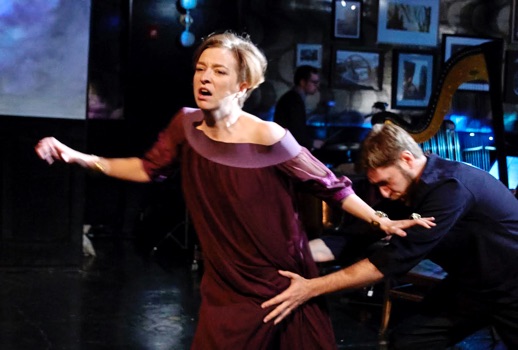
Production still from The Rape of Lucretia at LoftOpera

The production was simply staged, but very dramatically enacted for full and immediate impact. The cast, with which I was totally unfamiliar, was excellent, each and every one. The audience sat rapt throughout and, at the end, was very generous with its applause. All in all, it was a very groovy night and very exciting to discover this new company. Although specific repertoire hasn’t yet been announced, LoftOpera will be presenting 4 productions next year. If you’re in the area, I encourage you to check them out. These are professionally presented productions in intimate surroundings and adventurous locations, and at a fraction of the cost you’d spend at any other opera company.

CULTURE TIP: LoftOpera

And check out the New York Times review for your edification:

New York Times Review

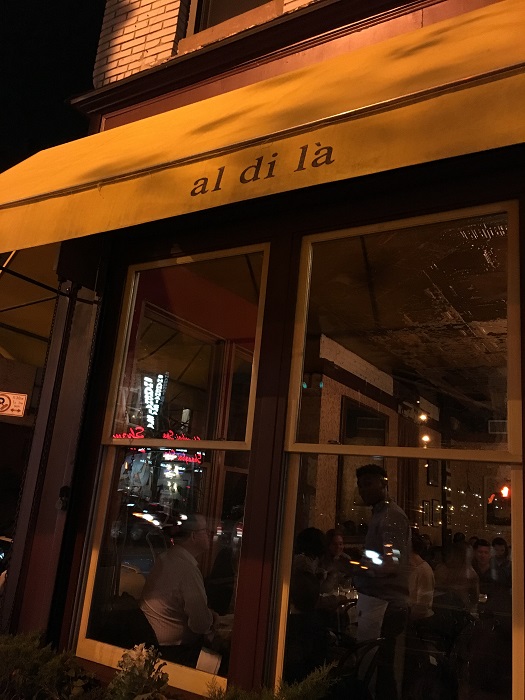
Because AAC CPA and I needed to be well fortified prior to the show, I sought out a place to grab a bite. Enter al di la Trattoria, on 5th Street in the Park Slope area of Brooklyn. I’d heard that they served seriously good Italian food. Again, my phobia about getting lost in the boroughs has held me back. Bad boy!! We had a delightful dinner last night.

al di la

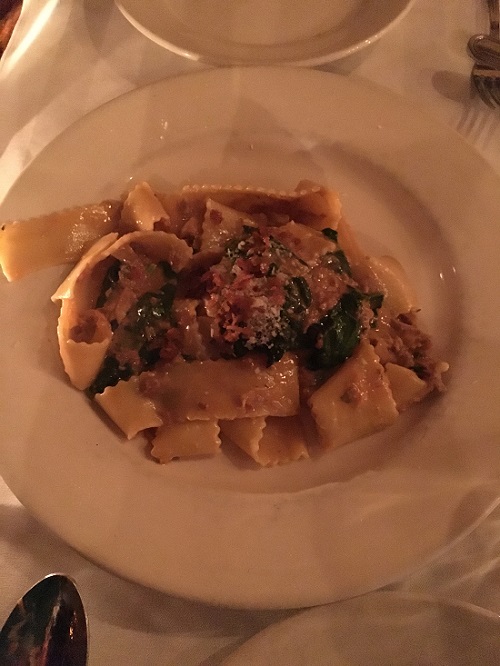
We weren’t able to sample their extensive wine list (no sleeping at the opera, damnit!), but we were delighted with what we chose to eat. We shared an Autumn Market Salad, beautifully shaved vegetables (except for the cauliflower, ewwww), and dressed in the lightest of dressings. Yummy. Followed by a special, pappardelle and duck ragu. OMG, it was so tasty.

al di la food
Talk about whetting your appetite!!!!

For mains, we went our own way: hanger steak with arugula for me (how healthy!) and the most tender pork chop I’ve ever tasted for AAC CPA. Our contorni was Crispy Squashed Beets with horseradish crème and chives. I’m telling you, it was a taste sensation, and totally worth the trip to Brooklyn.

CUISINE TIP: al di la Trattoria – Brooklyn

Speaking of trips to Brooklyn, perhaps that’s why God invented Uber?

Speaking of which: Remember when I talked about Uber last week and how it got us flawlessly around Fort Lauderdale? Well, we Uber-ed our way home after the opera last night and, not only did they pick us up within like 2 minutes, the trip back home was faster and cheaper than taking a taxi. And much more fun, ‘cause you generally travel in a nice car and the drivers are always friendly and chatty (but in a good way).

So, here’s the deal: if any of you are curious but have never tried Uber, use my code:

jeffreys567

and you’ll get $15 off your first Uber ride. (Full disclosure: apparently, I’ll get some kind of credit as well. That’s what I call a “win-win”.)

Travel Tip: Uber Sign-Up

That’s all for now, folks. Have a lovely weekend!!


Winging Home in Style

Hey, you guys! Originally, this entry was going to be a wrap-up of the vacation that’s just ending, and I’ll get to that shortly.

However, we had a little surprise on the way home today, and I just have to share it with you, if you don’t mind. So we’re flying back on jetBlue and, somehow, our boarding passes got all screwed up and our seat assignments changed before we arrived at the airport. And you know how we are – we like to sit together and all that.

It turns out that there was a last minute equipment change and the replacement equipment is the A321 that normally flies transcontinental and also has what is called “Mint” service, which is their version of business class. It includes flat-bed seats and all that stuff. So, just for fun, I approached the check-in desk at the gate to see if it was possible to exchange our seats for something “up-front”, as they say. Without blinking an eye, the gate agent assigned us 2 seats in the 1st row of Mint. (We later learned that their Mosaic passengers were upgraded automatically.) AAC says we got the switch because I was “properly attired”, something that he hitherto had always admonished me for. HAH!

And here’s our very own AAC CPA getting settled in for the flight home:

AAC Mint

jetBlue Flight 1902; AAC CPA in seat 1A

TRAVEL TIP: jetBlue Mint

So, a few random thoughts about our lovely 10-day vacation:

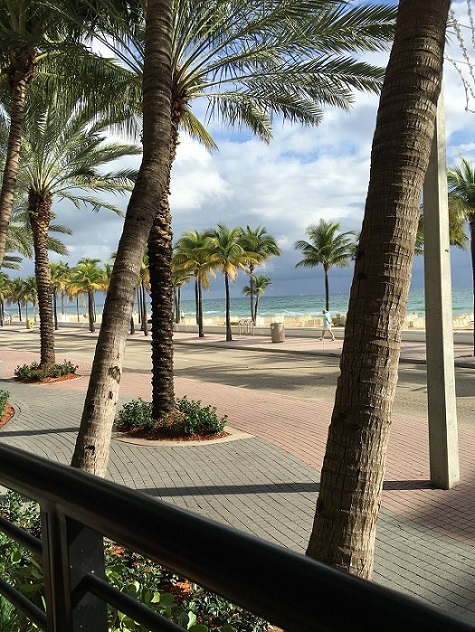
Fort Lauderdale is not a place that I’d often want to visit, but the Ritz Carlton took amazing care of us. We told them, when we checked out to embark Celebrity Silhouette, that we’d be back early the following Sunday morning. Sure enough, our suite was waiting for us when we arrived back at the hotel at 8:45 AM. It had a large balcony and a lovely ocean view, which I’ve already shared with you.

We had two excellent dinners on our return visit:

Mario’s Catalina Restaurant: Mario, originally from Honduras, is apparently a legend in Fort Lauderdale. His Cuban-Spanish restaurant has been a staple of local dining for eons. They make amazing Mojitos and Sangria, both of which are potent. The portions are HUGE, so we shared the Pork Tamale as an appetizer and the Catalina Combination (Roast Pork, Chicken Chunk, & Mario’s Beef) as the main. Each bite was a sensation; all of the meats are marinated for a very long time and so, so tender and tasty. And the bartender kept coming over and refreshing our Sangria. Mario himself appeared to make sure we were having a good time. 

DINING TIP: Mario’s Catalina Restaurant

On Monday night, we tried another place, Coco Asian Bistro & Bar, another fun place. It features amusing cocktails, small and large plates. We tried their Margaritas (yes, Margaritas at an Asian restaurant!) and shared several appetizers: Thai Beef Salad, Tuna Tataki (seared tuna with a spicy Ponzu sauce), and Chicken Lettuce Wrap and, for the main, la specialtie de maison: Whole red snapper (cubed filet, deep fried tossed with sweet-chilli sauce, reassembled in fish bone and head). It sounds disgusting (AAC CPA almost fainted when it was presented), but it was really delicious. Here are a couple of pix for your delectation:

Coco Apps

Appys at Coco

Coco Snapper

Too scary?

DINING TIP: Coco Asian Bistro & Bar

Because it was raining on Monday, we also had time to see the new film, Spotlight, which recounts the true story of the child abuse coverup by the Catholic Church in Boston and how the story was eventually uncovered by the Boston Globe. An excellent cast, headed by Mark Ruffalo, Liev Schrieber, Bryan d’Arcy James, Michael Keaton and the great Len Cariou as Cardinal Law. A very engrossing and thoughtful, if upsetting, film. It is expected to be a favorite for Oscar consideration.

CULTURE TIPSpotlight

Oh, and have I shared with that we are now totally onboard with Uber? They saved our bacon more than once while we in Fort Lauderdale. No kidding. It turns out that Uber is less than half the price than local cabs and easier to find. We have friends who have been swearing by the service for a long time, and we’ve finally come to the party. Try it out!!

TRAVEL TIP: Uber

Now for a few final thoughts on our cruise aboard Celebrity Silhouette. We thoroughly enjoyed the experience, the ship is gorgeous, our accommodation was lovely, the food some of the best at sea. But, in the final analysis, we thought it was just not for us. The cruise was a bit frenetic, the ship quite crowded, particularly around the pool areas, the wait for elevators was always too long. I think we prefer a smaller or mid-sized ship experience. It’s interesting, though, because we had a lovely crossing aboard Queen Mary 2 in September and that ship is easily as large as Silhouette, tho’ with a couple hundred fewer passengers. Even though Silhouette is perhaps a better designed ship than QM2, we preferred the latter. Go figure.

I’m actually considering a post that will compare the 3 lines upon which we sailed this year: Celebrity, Crystal, and Cunard. I already have a working title for it: “Sailing the 3 ‘C’s”- get it?

Anyway, our winged chariot will be landing soon at JFK in, so I’ll end here. I’m slightly aghast at having to step on a scale tomorrow morning and assessing the damage that I’ve done to myself. And, wouldn’t you know, I’m scheduled to have my annual physical this coming Friday morning, just as I’ve put on about 30 pounds (well maybe not THAT MUCH.)

I’ll leave you with just a few more images from our trip and I’ll be back in touch with you all real soon.

FTL ChipmunkAAC CPA’s Monday breakfast: doesn’t it look like Alvin the Chipmunk?

AAC Beach View
One last view of the beach this morning

AAC Sad

AAC CPA looking wistful and sad as the end of the vacation approaches

Next stop: London in 19 days!!

Greetings From 35,000 Feet and the Power of Tradition

Good afternoon, Ladies & Germs!

We’re currently at about 35,000 feet on our jetBlue flight from New York to Ft. Lauderdale (and the internet is FREE!!!). Tonight we’ll be staying at the Ritz-Carlton and, tomorrow at this very time, you may recall that AAC CPA and I will embark on Celebrity Silhouette for a 7-day cruise to and from the Caribbean. We’ve heard that it’s a gorgeous ship, so I’ll be blogging during the cruise to let you know all about it. Stay tuned.

JetBlue
Our winged chariot from New York to Ft. Lauderdale

So what’s been going on since my last post?

AAC CPA survived the packing process almost intact, bless him. We had no melt downs or hissy fits. Maybe he’s finally getting the hang of it. But wait: on the way to the airport, he started asking scary questions about packing for our trip to London in 4 weeks. Sigh.AAC at Airport    AAC CPA in the jetBlue lounge with a egg sandwich and a cuppa Peets

Fortunately, the packing had to be completed by last night, as we had tickets for the 1st preview of the new Broadway production of Fiddler on the Roof at the Broadway Theatre.

AAC Fiddler    AAC CPA at the 1st preview of Fiddler on the Roof last night

This new production is being directed by Bartlett Sher, who helmed the very successful productions of The Light in the Piazza, South Pacific, Golden Boy and, most recently, The King & I. He’s one busy fellow and a superlative director. His great talent, I think, is to respect the material and to mine it in such a way that he is able to create wonderful relationships between the characters. Anyone who’s already seen The King & I, now at the Beaumont Theater, may recall how thoughtfully he’s developed the East vs. West puzzlement in a way that gives equal weight to both cultures. He’s also strengthened the role of Lady Thiang to a degree that I’ve not seen before. She’s no longer an appendage to the King but, rather, the power behind the throne. (Whether the King realizes it or not is another matter.)

For a 1st preview, Fiddler on the Roof was in fairly good shape. The cast is headed by Danny Burstein as Tevye and Jessica Hecht as Golde, both of whom are extraordinary actors with long portfolios of memorable characters. Burstein is already giving a marvelous performance. He is, perhaps, the sweetest Tevye I’ve seen but, also, more conflicted than most when he has to deal with the breakdown of traditions happening all around him. Also, while Burstein has had a long and extremely distinguished career, I believe that this production marks the first time he has his name above the title and that’s more than well-deserved.

Burstein in Rehearsal
Danny Burstein in rehearsal

I had initially thought that Hecht was too luxuriously cast, and would be wasted in the role. Seemingly a bit tentative in the 1st act, she grew ever stronger over the course of the evening and created some very moving moments in the 2nd act. The remainder of the cast is uniformly excellent and seem to relish discovering their characters along with the audience, which is another tribute to Sher’s ability to put the right actor into the right role.

Fiddler      1st image of the Fiddler set (shhhh – don’t tell).

The original production was staged by Jerome Robbins and no one who saw it or its many revivals will be likely to forget his iconic choreography. This production, while respecting the original staging, chooses to go its own way. Bart Sher has brought in a different choreographer, Israeli choreographer Hofesh Shechter. His movement for the show seems to be an amalgam of folk dance, modern dance and homage to Robbins. Even at this early date, he’s getting great results from his company. As of now, only Tevye’s Dream didn’t land as well as it can and that’s probably just a matter of time. And, as usual, the Bottle Dance is a highlight of the performance. Shechter does Robbins one better by having 5 dancers for this sequence and it rocks!

Hofesh Shechter

Perhaps the best thing about this Fiddler is that, while faithful to the material, Sher has rethought every element to keep it fresh and timely. This production does not feel at all like a revival. There is a framing device, which I will not spoil for you, that makes this show feel more relevant than, perhaps, ever.

So, if you care about great Broadway musicals, I encourage you to treat yourself to this new production. It is one of the last great vestiges from the Golden Age of Broadway.

Fiddler on the Roof on Broadway

(Oh, and did I mention that it was a bit of a thrill to see Fiddler’s lyricist, Sheldon Harnick, sitting 2 rows in front of us? Even at 90+ years of age, he remains Broadway royalty.)

That’s all, folks. Next time you hear from me, I should be floating on the ocean.


Blog Detour – Bayreuth

Gentle Readers:

As I’ve previously mentioned, I’m enrolled in an online blogging course in order to improve my skills and, hopefully, to give you a better experience.

It turns out that today’s assignment is to write a post that builds on a comment that I posted on another blog that was of interest to me.

Therefore, I’ll apologize in advance for those of you who may say: “Why is he talking about that opera crap again?” But please bear with me, as you might find this post more interesting that you had originally thought.

Imagine this:

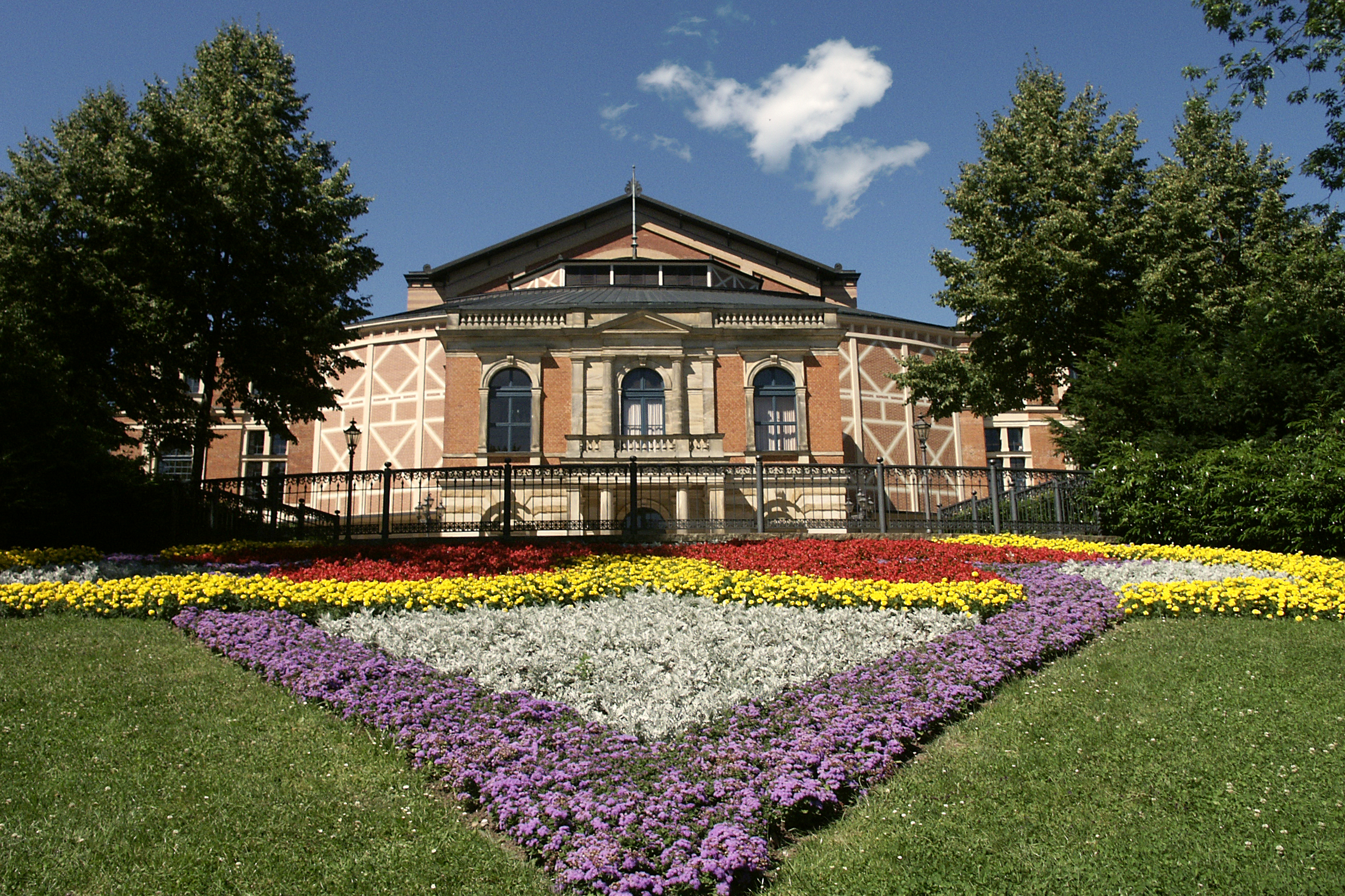
There is a opera house in Bayreuth (pronounced bye-roit) Germany, which was built between 1872 – 75 for the express purpose of presenting Richard Wagner’s magnum opus, Der Ring des Nibelungen. For those of you unfamiliar with the Ring, Wagner spent over 20 years composing these 4 operas or, more specifically, a Prologue (Das Rheingold) with 3 operas to follow (Die Walküre, Siegfried and Götterdämmerung). If nothing else, the audacity of an artist creating an entirely new style of music and operatic presentation spread over 4 evenings (and 15+ hours) has to be respected. This grand work would be presented as a Festival and, indeed his theatre is called the Festspielhaus (Festival House). The demands (and, hopefully, the rewards) of presenting the Ring placed upon the singers, orchestra, designers and, not least, the audience, would be unprecedented.

Bayreuth - R Wagner
Richard Wagner – The Meister

Why Bayreuth? Wagner wanted a location that was far away from virtually anything that would interfere with the audience’s complete concentration on and attention to his Ring. Additionally, he needed a huge stage on which to present the operas. There is another opera house in Bayreuth that Wagner thought might work, as the stage was unusually deep. However, when Wagner saw the opera house, he thought it was too rococo for him and the Ring. He wanted something much simpler that, again, would not distract his audience from what he had called his Gesamtkunstwerk, defined by Webster as “an art work produced by a synthesis of various art forms (such as music and drama)”.

Bayreuth - the Other Opera House
The other opera house – too rococo??

And another challenge that continues to this day: Bayreuth is not easy to get to (unless you live somewhere in Europe and like to drive). The first time I attended the Festival, I was able to fly from New York to Frankfurt and then fly on a “puddle-hopper” to Bayreuth. Nowadays, you’d need a private plane to fly into Bayreuth, which, in the alternative, leaves you with a 4+ hour train ride from Frankfurt (with a change of train in Nuremberg). It’s a LONG trip!

Bayreuth Map
How to get to Bayreuth

In order to get his theatre built, Wagner finagled the funds from mad King Ludwig of Bavaria, who was entirely under Wagner’s spell ever since he had seen a performance of Lohengrin as a child. (Wagner had that effect on many people. He was, by most accounts, a terrible person but, arguably, the most important and influential artist of the 19th century.)

Bayreuth Ludwig
King Ludwig of Bavaria

The theatre was unique when it was built and still is. Inspired by the Greek amphitheaters, the main floor is fan-shaped and has 30 rows. Behind and above are several sections (loge and balcony) and, of course, a royal box for the Swan King (Ludwig). There are 1,900 seats altogether and no boxes for the “important people”. Seating was intended to be entirely democratic.


The Festspielehaus

Bayreuth - Interior
Inside the Festspielhaus

The most unusual feature of the theatre is that the orchestra pit is famously and entirely concealed from view of the audience. Wagner intentionally designed it this way so that there would be no distractions when watching his grand works. Additionally, Wagner’s theatre was the first ever to present the operas with the house lights entirely turned off, an innovation at the time. In this way, the audience, sitting entirely in the dark, couldn’t “yoo-hoo” at friends and frenemies during the performance and had to pay attention. The beginning of Das Rheingold with its ominous E-flat bass notes which morph into the music of the Rhine river is played in complete darkness, so dark that you can barely see your hand in front of your face. Imagine what that must have been like for audiences accustomed to a totally different experience when attending the opera. It was nothing less than revolutionary.

Bayreuth Orchestra Pit
The invisible orchestra pit

Wagner originally had the crazy idea that he would build this theatre, the Ring would be presented and, afterwards, the theatre would be torn down. Well, that didn’t happen, did it? Wiser heads (including his own) prevailed and after the world premiere of the completed Ring in 1876, plans were immediately made for another Festival at which all of the mistakes of the first year (and there were many, many mistakes) would be corrected.

But it was another 6 years before the next Festival and, as it happened, the Ring was not presented. Instead, it was the world premiere of Parsifal that the audience heard and which Wagner had composed with the Festspielhaus’ unique acoustic in mind. This time, Wagner had a complete triumph: the perfect opera, with the perfect cast and a perfect production (perfect, at least, for 1882). Buoyed by this success, plans were made to get the Ring back into the theatre pronto. And then, 6 months later, Wagner died in Venice.

It took several years, but the Festival was eventually resurrected by Wagner’s widow, Cosima (who, incidentally, was the daughter of Franz Liszt).

Bayreuth R Wagner Cosima Siegfried
Family Portrait: Cosima, Siegfried, Richard

Over time, certain traditions were created that continue to the present day. It was decided that, in addition to the Ring and Parsifal, only the Master’s mature works (Der fliegende Holländer, Tannhäuser, Lohengrin, Die Meistersinger and Tristan und Isolde) would be presented. Without fail, the Festival would open each year on July 25th and close on August 28th. The Festival would be a workshop, at which each production would be presented for several years and, in each successive season, return to the rehearsal studio to refine, improve and rethink each opus.

After Cosima’s death, the Festival was handed over to her son, Siegfried (who, by the way, was GAY, but people didn’t talk about such things back then). Upon his premature death in 1930, the Festival was taken over (stolen??) by his widow (wait – he was MARRIED????), Winifred, who presided over the Festival for the next 14 tumultuous years.

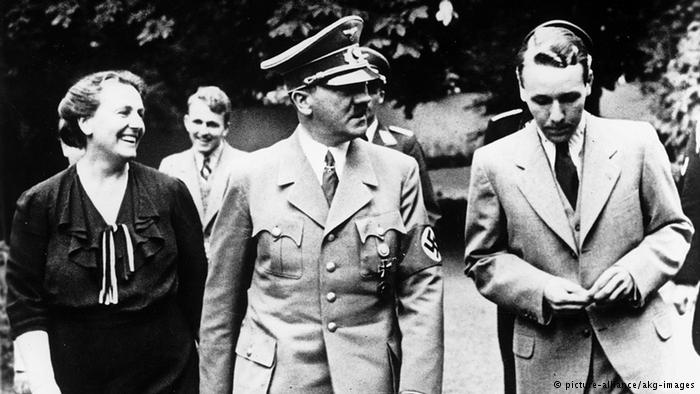
You see, during the 1920s, she had become friends with this up and coming politician with whom she was much enamored. In fact, she was so bewitched by this charismatic young man that, or so the story goes, she provided him with the paper on which he wrote his most famous book: Mein Kampf. And that’s how Adolf Hitler – who was Richard Wagner’s #1 fan – came to be a fixture at Bayreuth through the 1930s and, finally, the 1944 Festival, after which the theatre shut down (almost for good).

Bayreuth - Hitler
Winifred, Adolf and Wagner Progeny

But wait: Siegfried and Winifred had 2 sons – Wieland and Wolfgang who, after the war (and after being denazified), were allowed to reopen the Festival in 1951. Because there was no money, and because there could be no compromises on the presentation of the music, Wieland caused another revolution by what he put on the stage which was, basically, nothing except the singers, some very simple set pieces (such as a circular platform for the presentation of the Ring) and the most effective lighting that had to that time been seen in a theatre. It caused a sensation: although the old guard was outraged at what they were (or more correctly, weren’t) seeing, there were others who were enchanted and, in fact, relieved not to be seeing all that Teutonic stuff strewn all over the stage.

I think it was a masterstroke of luck that the Festival was practically bankrupt after the war, which enabled Wieland and, to a much lesser extent, Wolfgang (who didn’t possess anywhere near the talent of his brother) to create a new style of presenting their grandfather’s work, which completely severed it from any connection to Hitler and the Nazis. In fact, Wieland was solely responsible for ushering in “Der Neue Bayreuther” or New Bayreuth.

Compare and contrast:

Bayreuth - Original Rheinmaidens
The original Rhinemaidens, 1876

Bayreuth - Chereau Rhinemaidens
Patrice Chereau’s Rhinemaidens, 1976

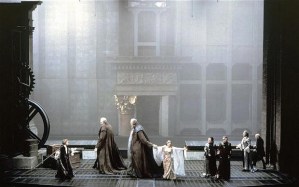
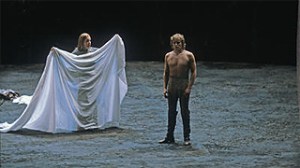
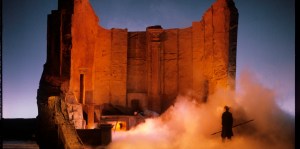
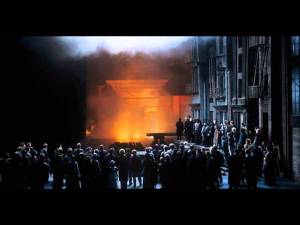
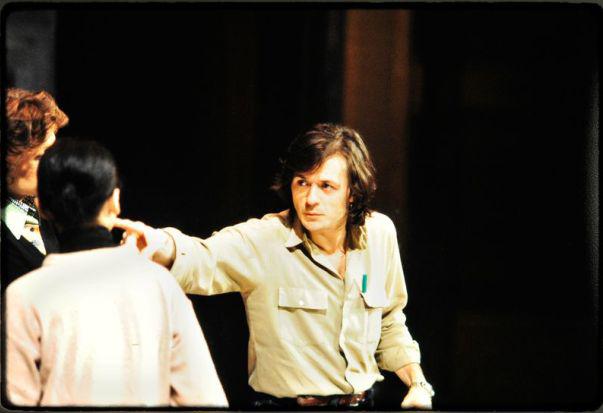
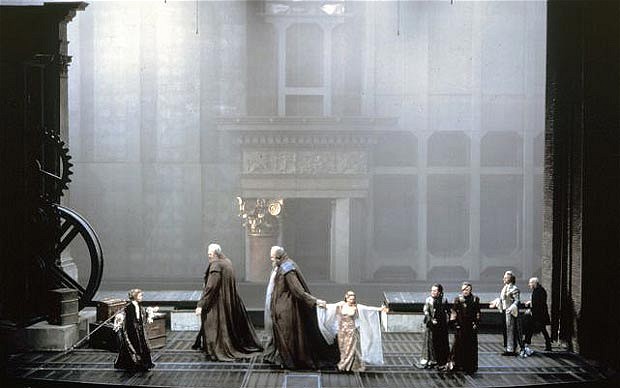
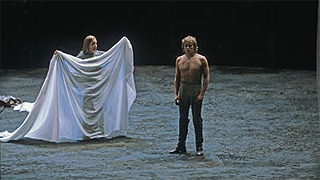
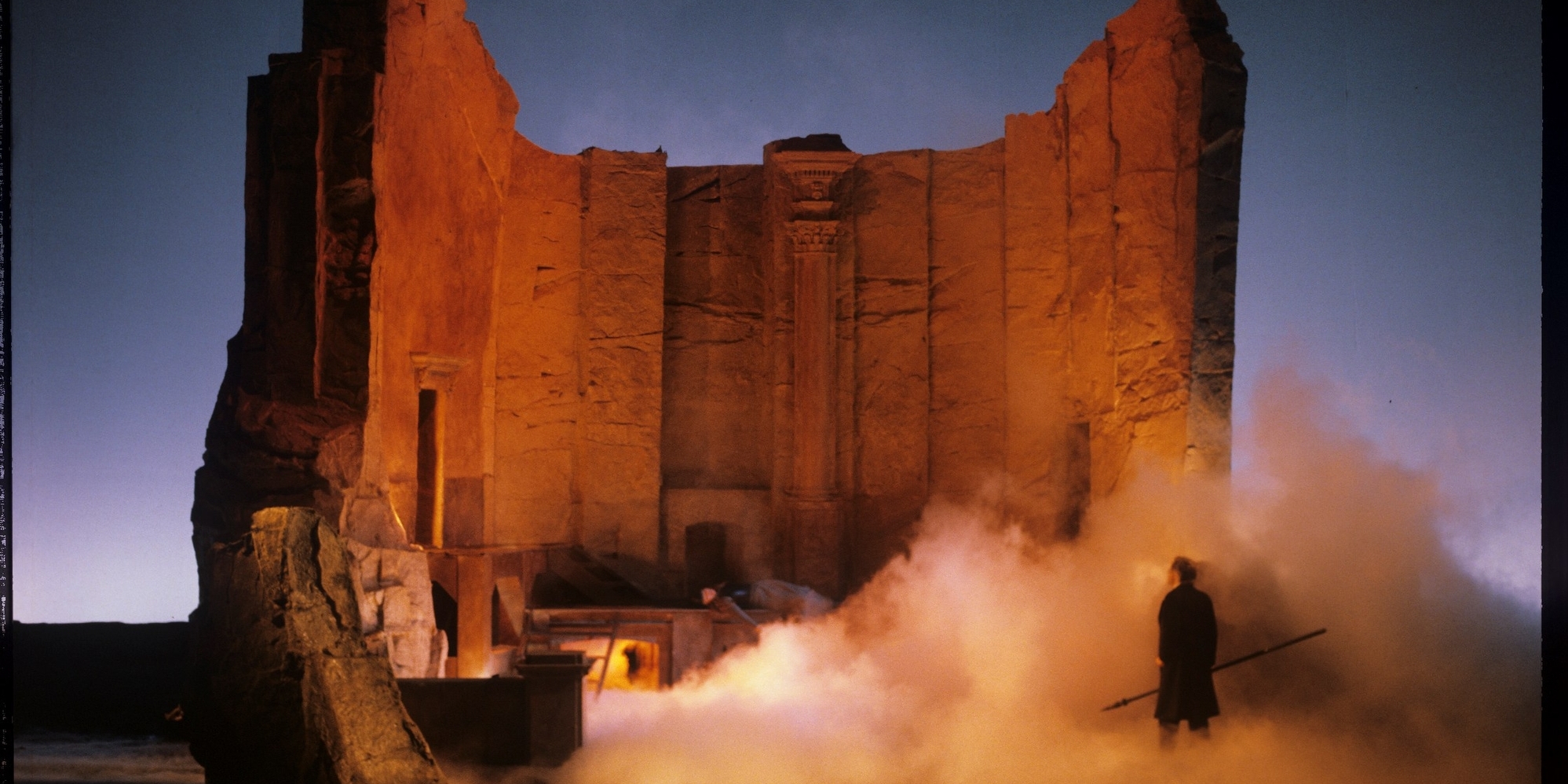
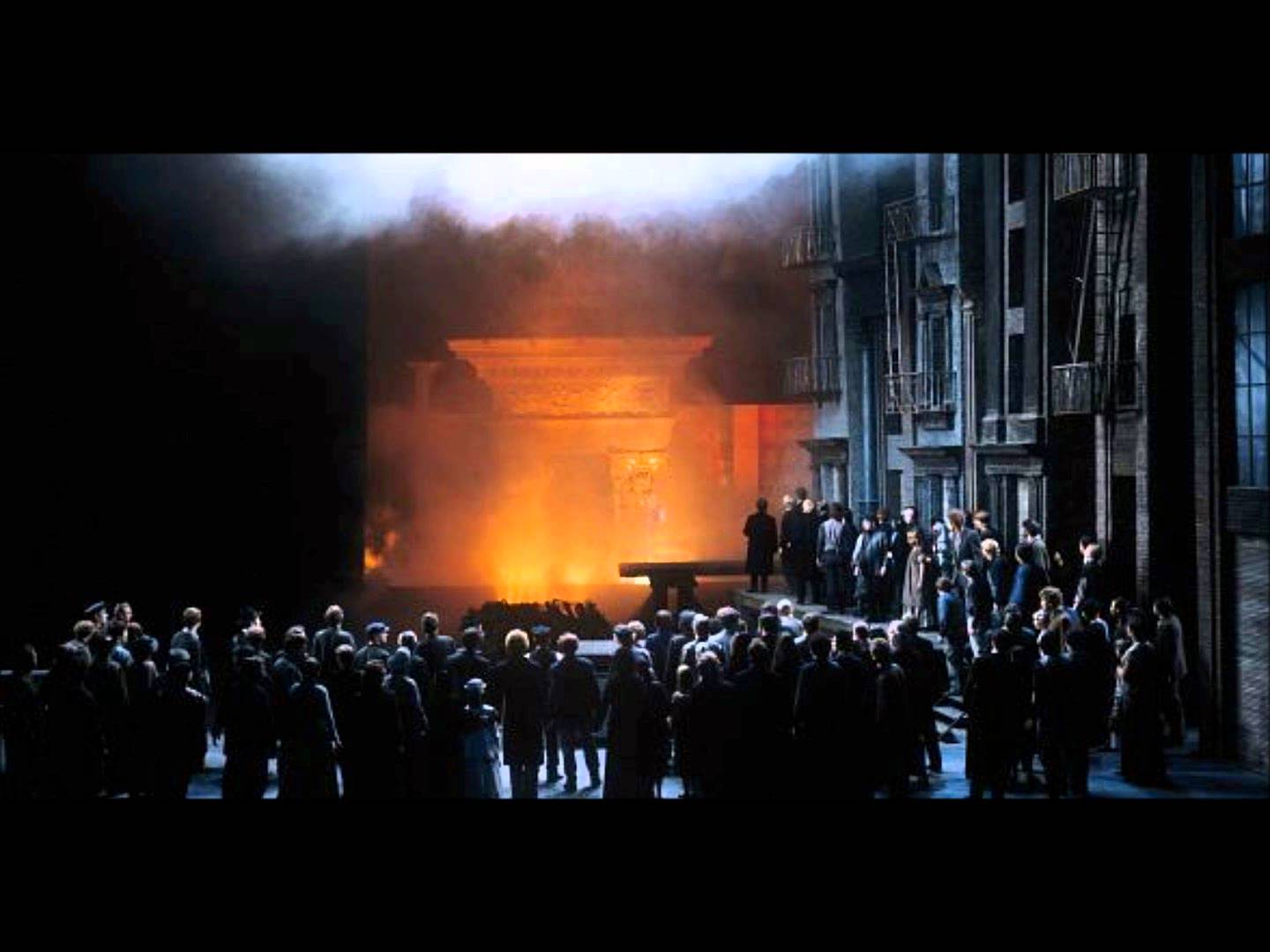
Since 1951 and the reopening of the postwar Festival, there have been more revolutions: the Centenary Ring in 1976, staged by the late, great Patrice Chereau and conducted by Pierre Boulez. It was Chereau’s concept to present the operas in Wagner’s own time (and during the Industrial Revolution) and to focus on the evils of capitalism and anti-Semitism. Chereau, who had directed only one opera before taking on the Ring, was a masterful director who had no preconceived notions about these operas and worked from the text. The singers in this production who most benefitted from working with Chereau – Gwyneth Jones as Brünnhilde, Donald McIntyre as Wotan, Peter Hofmann as Siegmund and Heinz Zednik as both Loge and Mime – gave the performances of their careers and presented acting that was so natural and believable that it created a very special experience for the audience.

Bayreuth - Chereau ca 1976
Patrice Chereau, ca. 1976

Bayreuth Chereau Rheingold

Bayreuth Chereau Walkure Jones Hofmann

Bayreuth Chereau Walkure

Bayreuth Chereau Gotterdammerung
Images from the Chereau Centenary Ring, 1976

Two interesting anecdotes about these premiere performances:

The initial performance of each opera was broadcast around the world and the audience grew more and more testy as each production unfolded. Now it wasn’t necessarily unusual to hear booing at the Festspielhaus at the end of a performance, but how about at the beginning of Act III of Götterdämmerung DURING THE MUSIC?? You can actually hear the opening of the act, imagine the curtain rising and, then, there it is – LOTS of boos, along with some segments of the audience “shushing” the dissenters, or were THEY the dissenters?? The production was so controversial that it’s hard to tell.

Fast forward to the Festival of 1980 and the retirement of Chereau’s Ring. I happened to hear the very last performance of  Götterdämmerung on a radio broadcast and what a difference 4 years makes. At the conclusion of Götterdämmerung, the curtain calls (and cheering, no boos this time) lasted for something like NINETY minutes! Whatever it was that repelled and outraged the audience in 1976, they were now completely under the spell of a masterful and game changing production.

So, after all that, you wanna go to Bayreuth? Any opera lover worth her salt should make that pilgrimage at least once. Hold on. It’s not that easy.

Remember when I said that the theatre had 1,900 seats? Generally speaking, there are 30 performances presented each year for a total of 57,000 available seats. However, attendees to Bayreuth are not going to travel all that way to see one show – they’ll probably want to see everything presented that season (usually the Ring and 3 other operas).

So, there are 57,000 available seats. But each year, the Festival gets something like 250,000 requests for seats. And each of those people wants to see everything, too. In the past, ticketing was managed by the “Wagner computer” and, if you applied every year without fail (you’d be punished if you missed even one year), the typical waiting period to actually get seats was about 10 years!!! Nowadays, some tickets for each season are available on the internet at the Festival’s website and, if you’re fast and lucky enough, you might even secure seats. These intrepid souls may actually hop to the front of the line and get in, and good luck to you!

As if that weren’t enough, Wagner never factored comfort into the design of the theatre. What do I mean? Well, for instance, the seats are pretty uncomfortable (not much padding and no arm rests) and the theatre is not air conditioned. This may not seem like much, but I’ve been to Bayreuth during incredible heat waves and the temperature inside the auditorium rises to over 100 degrees. In the old days – I don’t know about now – formal attired was REQUIRED, so there you were in your tuxedo with the sweat running down your back.

And did I mention that Wagner’s operas are LONG?? Das Rheingold, the “prologue” to the Ring, runs anywhere from two hours, fifteen minutes to two hours, forty-five minutes (depending on the conductor) and is played in ONE ACT!!!!! No intermission!!!!!!! No bathroom breaks – no one would DARE to attempt to leave the theatre during a performance, and you couldn’t even if you wanted to!!! And in a theatre in which, during a heat wave, you could bake a cake!!!!!

But guess what? It’s totally worth it. On the right night, with the right singers and conductor, and with a director who knows what s/he’s doing, you will have the most magical, inspiring and moving experience you’re likely to have in an opera house.

CULTURE TIP: Bayreuth Festival Website

PS. Part of my assignment is to link this post to the blog which inspired it. Here ’tis:

Emily Abroad

Travel Fantasy Memory – Bucket List Item: Flying Air France to Paris

It started like this in June, 2014:

You – in this case: AAC, CPA – see a poster on the street alerting you to an upcoming exhibit that’s right up your alley (and, best of all for AAC, is free!). And there it is:

AF is in the Air
Invitation to an exhibit

What a cool thing to do of a summer Saturday afternoon in Chelsea, right? So, after meeting friends for brunch, we head over to the far west side on a street full of interesting art galleries (who knew?) and then into a loft building.

An attractive young woman outfitted in a beautifully tailored Air France uniform greets us. In fact, as we move through the exhibit, there seem to be dozens of Air France uniforms all around us, smiling, helpful and very welcoming.

And what, exactly, is the exhibit? Throughout, you see Air France memorabilia: photographs, videos, samples of their beautiful crystal, china, silverware, etc.

AF Model

AF Cards

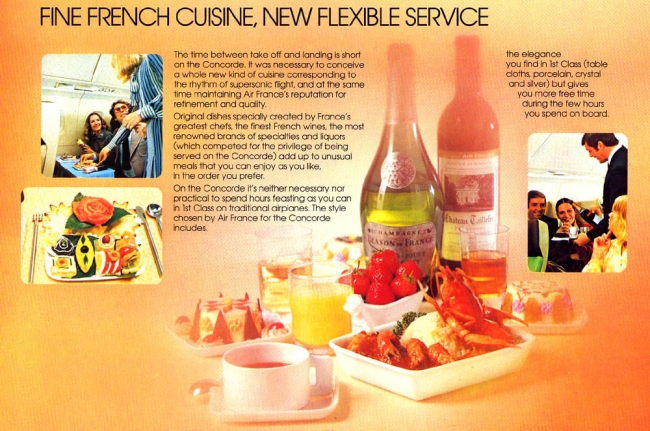
AF Concorde Dining

There’s also fun, silly stuff to walk through. Even a kids area where they can play and run around while their folks ogle the exhibit.

2014-06-28 13.55.46
AAC CPA attends an exhibit and has fun

But, mostly, as you work your way through, you can sample the various cabin classes on board, which is the real purpose of the exhibit. Air France wants to put butts in seats.

In fact, if you want to try out the seats, go for it!

We start in economy (meh) – looks like lots of seats pushed together.

AF Economy

Premium economy is next – getting better, as there’s a bit more legroom – 6 inches more pitch.

AF Premium Economy

Business? Now we’re getting warmer, the seats are comfortable but, also, angle-flat, not flatbeds – phooey!!

AF Business
See what I mean about “angle-flat”?

And then it happens, you go through a curtain and, suddenly, you’re in first class (a/k/a La Premiere). And you gasp just a little bit and your heart may skip a beat. It’s magic time.

AF - 1st - New Product
La Premiere – Pretty swank, huh?

Wouldn’t you just know? This is the one cabin of the plane where you can’t sit in the seat!! “Make ‘em beg for more, and then DON’T give it to them!” The creeps!

After seeing the first class cabin, there’s nowhere to go but down. Literally, that is, as it’s the end of the exhibit. But on the way out, those cute AF uniforms give you posters and the best ice cream sandwich ever. And both are yummy. So are the uniforms, come to think of it.

Cross cut: While all this is going on, we’re aware that a Broadway bound production of An American in Paris will be playing its out-of-town tryout at the Théâtre du Châtelet – IN PARIS!!!! So, in his ever-so-sweetly passive-aggressive way, AAC CPA just casually suggests “Wouldn’t it be fun if we could see An American in Paris (in Paris)?”

An American In Paris

Yes, gentle readers, AAC CPA knows how to push-my-buttons.

From there, I’m off and running (actually sitting at my laptop):

First thing: When, exactly, is the show playing in Paris? Easy enough to find out, just go to the Châtelet website and – wait for it – OMG: it’s playing over the holidays. Are seats even available? How about 10th row center on Christmas Eve?? Woo-hoo! Hold that thought.

Next: Take a big breath and head over to the Air France website and find out what’s available for a round-trip to Paris over Christmas week. It’s the holidays, so it’s going to be difficult to get seats, right?

What I see stuns me. Based on what we’ve heard, flying on Air France in first class (excusez moi – La Premiere) has been a bucket list fantasy dream for a long time. But we couldn’t possibly – the fares would be over-the-moon-too-expensive-out-of-our-budget-impossible.

But wait, for some unexplained reason, the fares over the holidays have been discounted by something like 70%. And, on top of all that, we’d get to fly on the new A380. Whaaaaat? Do my eyes deceive me? Apparently not. Now, I’m not going to lie and tell you that it wasn’t beaucoup bucks but, on the other hand, who doesn’t want to take advantage of a great deal, at least once?

AF A380
The new double-decker A380

Reminder to myself: How lucky are we that we could even consider such an indulgence?

So, then I call AAC CPA at work (yes, he was still doing THAT), and said: “OK, buster, you planted this seed – how would you like to go to Paris for Christmas and, oh by the way, fly over and back on Air France (traveling in La Premiere!, no less) and, yes, see An American in Paris on Christmas Eve?”

Yes, I called his bluff and what could he say but: “Well, OK, sure.”

And in a couple of mouse-clicks – I had windows open for both Air France and the Châtelet – we locked in our fantasy holiday trip: We were going to be two Americans in Paris, seeing An American in Paris on Christmas eve– IN PARIS!

Seriously, how lucky ARE we??

Next time: the Air France treatment (or, “Is there any way that you can make this flight LONGER?”)

Don’t miss VERITAS – presented by The Representatives

For those of you in New York who have time between now and Saturday, November 7th, you have 4 chances remaining to see The Representatives’ production of Veritas, by Stan Richardson, co-directed and co-produced by Richardson and Matt Steiner (who is also a member of the cast). I cannot recommend this production highly enough.

Veritas Cast
Cast of Veritas

Veritas deals with a shameful witch-hunt that occurred at Harvard University almost 100 years ago and destroyed the lives of a dozen students. The play was originally performed at the 2010 New York International Fringe Festival, where it had the distinction of being the first Fringe production to sell out before it even opened.

The incident came to light only in 2002, when a researcher from the university’s undergraduate newspaper, The Crimson, discovered a box of files labeled “Secret Court”. The paper’s staff subsequently had to battle the university’s administration to make public the over 500 documents relating to the Court’s proceeding. Finally, on November 21, 2002 the Crimson published an article entitled Fifteen Minutes, which made public this shameful piece of history.

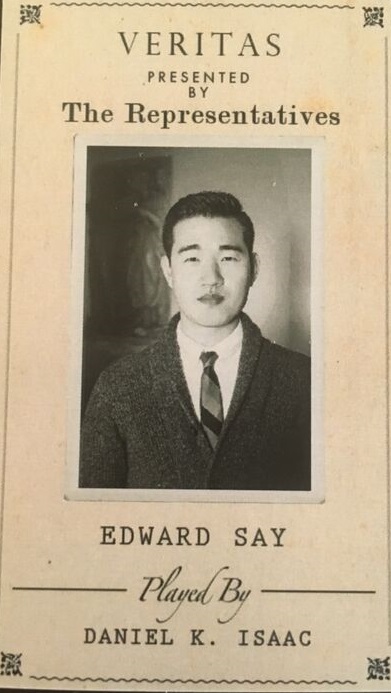
Attending a Representatives production is a unique event in itself. When we arrived at the Omsted Salon (a series of rooms at Calvary/St. George’s Church near Union Square), instead of tickets we were handed something akin to a baseball card with a photograph of one of the actors with his character’s name on it. We were told that he would eventually seat us in the first of two performance spaces in which the play would unfold. We were then invited to lubricate ourselves with our choice of complimentary wine or water.

Veritas
Our entry card into the performance

As we approached the beginning of the performance, “Edward Say” arrived to escort us to our seats. Along the way, he explained the mise en scene and told us a little bit about his character. And then he refilled our wine glasses! Thanks, Mr. Say.

The space for the first act was a long narrow room seating probably no more than 100 spectators, and probably a bit fewer. The staging took place in and all around us. You felt as if you were in the middle of the action.

At the conclusion of the first act, a 10-minute intermission was called and we were asked to move back into the space where we had started for more wine. It was there that the play resumed. Midway through the second act, we were directed back into the other room, which had been reconfigured and where we saw the remainder of the play.

Following the performance, we were invited to attend the “after-party”, so that we could hang out and mingle both with the audience and with the cast.

Since 2012, The Representatives has presented over a dozen new works, in site specific settings, many of which take place in apartments (yes, friends of the company “host” productions in their apartments!) to the Olmsted Salon, where we attended last night’s performance.

In their own words, “The Representatives’ dedication to presenting work as soon as it’s written – in people’s homes and other unconventional spaces – has created an underground following committed to hyper-intimate theatrical experiences. Committed to creating a community as much as making art, every performance of ours’ is followed by a party, creating a unique space for our increasingly diverse community to engage in enjoyable (if sometimes uncomfortable) conversations they might not find in their day-to-day lives.”

Tickets are priced at $20 and wine and the after-party is included. Get there if you can – you won’t regret it.

Buy Tickets to Veritas

NY Times Review

Hello – I Must Be Staying!

Hey Everyone!

So, it’s been just about 7 weeks since I started TheCulturedTraveler and I’m thinking that I want to recap what’s been happening with the blog and the life.

OK – full disclosure – I was offered a “blogging 101” primer to help me improve my blogging skills (such as they are) and, perhaps, to breathe new life into this adventure. I’m game for it and eager to see what may happen as a result. Of course, that means that I’ll have to do my “homework”, which means you may be seeing a lot more of me over the next few weeks.

For those of you who have stuck with me (and many, many thanks for that), you’ll know that I had a lot of friends who have encouraged me over the years to share our travel experiences, as well as our culinary and cultural adventures. Living in New York City, we’ve had the very good fortune to take advantage of all that this amazing place has to offer, and we’ve been equally lucky to be able to travel hither and yon and to meet some wonderful people along the way.

Version 2
Blog Highlight #1 – AAC CPA gets ready for takeoff.

Finally, just before our Queen Mary 2 crossing in later September, I took the plunge and, even since, have posted about 2 times a week. What’s been really interesting to me is that the travel posts get a very good readership, while the posts pertaining to culture and food, less so. That’s something I’ll have to figure out as we go along.

03 - Vogue
Blog Highlight #2 – AAC CPA on Embarkation Day aboard QM2

My goal is to connect with fellow travelers, culture and food mavens and to share experiences. I’m pretty good on all of these tracks, but I’m also fortunate to have good friends who share their experiences as well which gives me – well – food for fodder.

IMG_1388
Speaking of food for fodder: Blog Highlight #3 – Post-theatre dinner at The Ivy in London

I’ve had some success so far in connecting with other bloggers who somehow found TheCulturedTraveler, and that’s been great. It’s given me other blogs to read and, from them, to get ideas about things that I might want to do myself. Hopefully, that’s what my blog will do in turn.

Looking a year ahead, where would I want the blog to be? Here are some initial thoughts and goals:

  • I’d like to build the blog so that it can be used as a resource for like-minded people.
  • I’d like to attract a larger following giving TheCulturedTraveler more exposure.
  • I’d like to make the blog itself more attractive with, perhaps, more bells and whistles, so as to make it more interesting to the people who come to visit.
  • I’d also like to arrange for “guest-bloggers” to take over the space from time to time and share some of their experiences.

Finally, I’ve enjoyed posting so far and hope that I feel the same way as time goes by.

As always, thanks for reading stay tuned for more of our adventures.

Lulu Dress
Today’s Blog Highlight – Attending the dress rehearsal of Lulu at the Met

SEX! LUST! MURDER! DEPRAVITY!! LULU RETURNS TO THE MET

Considered by many to be the greatest opera of the 20th century, Alban Berg’s 2nd and final opera, Lulu, will open in a new production by William Kentridge at the Metropolitan Opera on Thursday, November 5th. It is one of the most anticipated performances of the season.

See the Trailer for Lulu

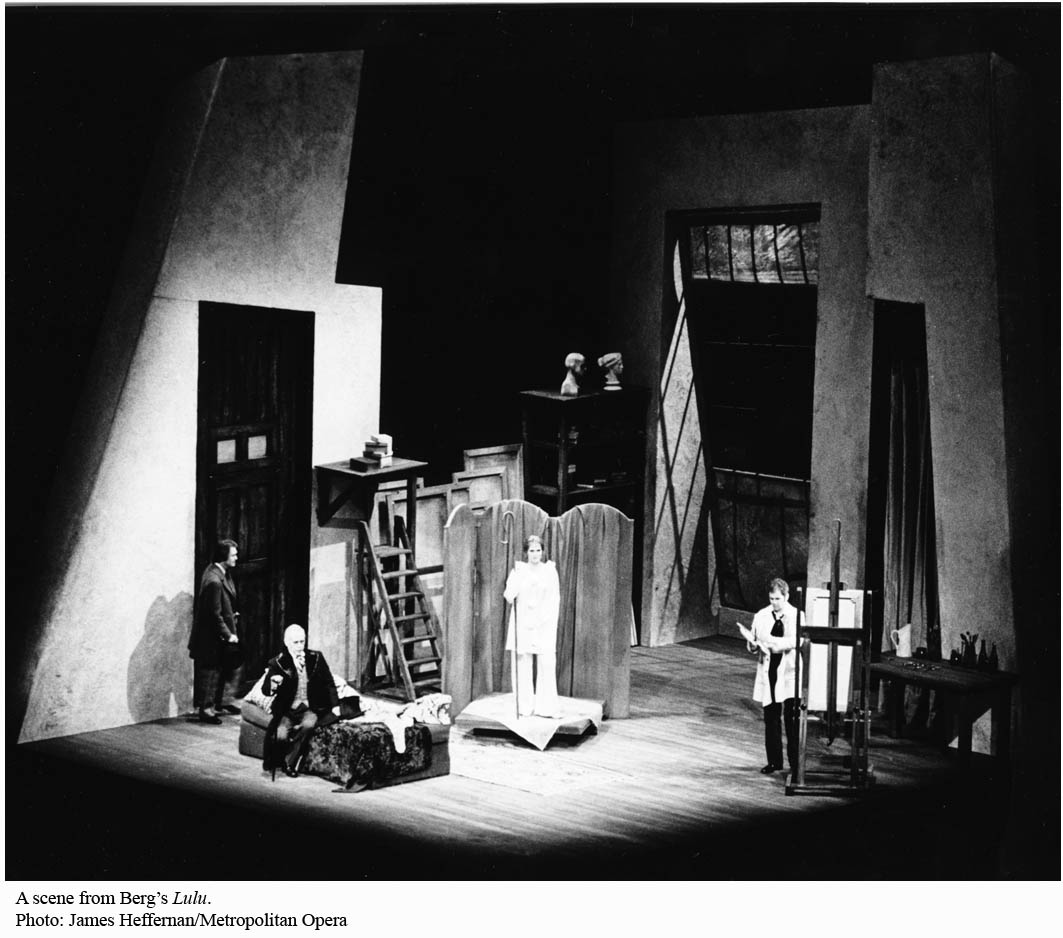
Lulu had its Met premiere on March 18, 1977, in a John Dexter production, conducted by James Levine and with Carole Farley in the title role. At the time of his death in 1935, Berg had completed only portions of the 3rd act (including the opening, the interlude between scenes one and two, and the grim finale). The Met performed acts one and two and, then, interpolated a third act by using the material that Berg had completed, adding music from his Lulu Suite and spoken dialogue from the source material, Frank Wedekind’s two Lulu plays.

Lulu - 1977
Lulu at the Met in 1977

Even though Berg had left an incomplete score, there was enough material available for it to be finished. Following Berg’s death, Austrian musician Erwin Stein prepared a vocal score of the complete 3rd act, working from Berg’s sketches.

Berg’s widow – Helene – reached out to influential composer Arnold Schoenberg to complete the orchestration of the 3rd act, a task he at first accepted, but subsequently declined. The public story is that, upon reflection, he decided that the scope of work would be too time consuming; another explanation for Schoenberg’s change of heart is that he was offended by the use of an anti-Semitic slur – “Saujud” or “pig-Jew” – in the libretto. Helene, being fiercely protective of the opera, thereafter refused to allow anyone else to complete the 3rd act and, until her death in 1976, the opera was performed in the two-act version and sometimes, as in the 1977 Met production, a 3rd act was interpolated from material that was available.

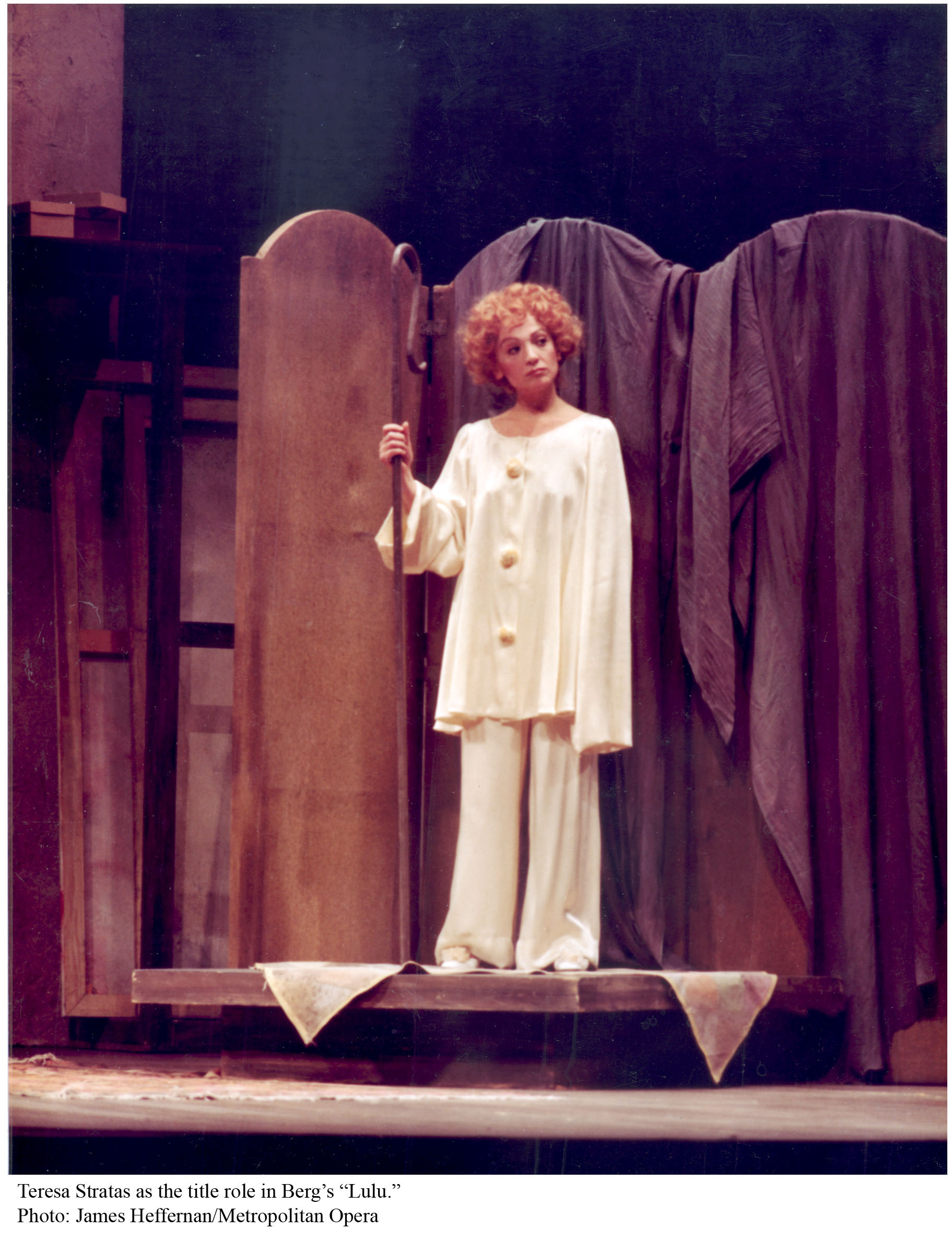
Immediately following Helene’s death, the rights to complete the work became available and the project was entrusted to Viennese composer and conductor, Friedrich Cerha. Although his work was not finished in time for the 1977 Met performances, the world premiere of the complete Lulu was presented by the Paris Opera on February 24, 1979, conducted by Pierre Boulez, produced by Patrice Chereau (who, three years previously, had had a hugely controversial success with his production of the centenary Der Ring des Niebelungen at the 1976 Bayreuth Festival), and with famed Canadian soprano Teresa Stratas in the title role. The Met premiere of the three-act Lulu was in December 1980, again with Levine on the podium and Stratas onstage as Lulu.

Lulu - 1980
Teresa Stratas as Lulu – 1980

Berg based his opera on two plays by Frank Wedekind: Earth Spirit (1895) and Pandora’s Box (1904). (If Wedekind seems familiar to you, it’s because it was his source material that was used in the 2006 Broadway musical, Spring Awakening.)

A new production of Lulu is always met with great anticipation because of the demands placed on all participants – from the conductor to the singers to the director and the designers, and, not least, the audience – everyone is challenged to up his game.

What is it about Lulu that is so exciting and, yet, so formidable?

While it can be argued that many operas are music first and theatre second, Lulu is theatrical to its core. To borrow an unattractive phrase used to describe the “old style” of operatic acting: you cannot park and bark but, rather, you must give a fully committed performance both musically AND dramatically. Both the Chereau and Dexter productions were not only fastidiously musical but, also, fabulously theatrical and cast with amazing singing actors, led by the charismatic Stratas.

There are no fewer than 24 characters and, for purely dramatic reasons (and as indicated in Berg’s score), some singers play multiple roles. The title role requires not only the embodiment of the ultimate femme fatale, but also a voice that can handle a huge vocal range, coloratura, and declamation. In order to succeed, whoever portrays Lulu must also have star quality and the ability to seduce every character (less one) onstage as well as everyone in the audience. It is a tall order.

I am no musicologist by any measure, but I can tell you that the musical structure of Lulu is like a palindrome, which is fitting for the rise and fall saga of Lulu herself. While the musical composition relies on the 12-tone system, Berg brought to his score an intensely romantic approach. Operagoers who might be asked: “What would you prefer to see tonight – Aida or Lulu?” – will invariably choose the former because they believe that the music of Verdi will enchant them; but the more discerning operagoer must always choose Lulu: first, because it’s rarely presented and, more importantly, the musical riches and beauty of the score are irresistible.

The Met’s new production of Lulu will be directed by the great South African artist William Kentridge. He is renowned for his prints, drawings and – especially important to any production of Lulu – his animated films. He made a spectacular debut at the Met in 2010 with the company’s premiere production of Shostakovich’s opera, The Nose. Anthony Tommasini reported in his New York Times’ review of March 6, 2010:

“It has become commonplace at the Metropolitan Opera for directors and designers of new productions, especially modernist high-concept ones, to be lustily booed by a sizeable contingent of the audience during opening night ovations.

“But on Friday night, when the met introduced its production of Shostakovich’s early opera, ‘The Nose’, the South African artist William Kentridge, who directed this production, helped design the sets and created the videos that animate the staging, received the heartiest bravos.”

Lulu plays to all of Kentridge’s strengths as a director. Here is a brief interview with him from the Met’s website:

William Kentridge discusses Lulu

Print Interview with William Kentridge

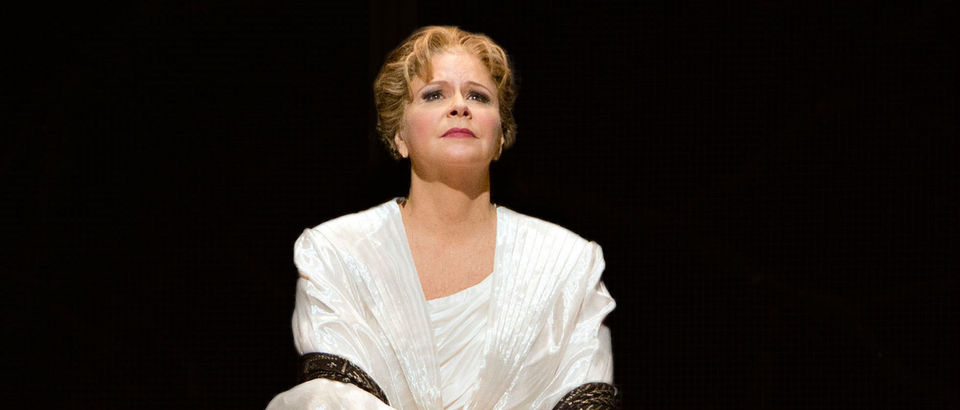
The Met has assembled, arguably, the most luxurious cast available today. Marlis Petersen is today’s “go-to” Lulu, having appeared in many productions going back to 1997. Besides having the vocal chops to get through this marathon role, she is also a stage animal who makes this character come alive in the most disturbing ways. I saw her in the last revival of the Dexter production about 5 years ago and she was sensational. From Steve Smith’s New York Times’ review of May 9, 2010:

“In the German soprano Marlis Petersen, the Met has a charismatic, technically assured protagonist. That Ms. Petersen’s Lulu was rarely seductive in any genuine sense seemed to be precisely her point: more often than not, she was both a scarred adolescent fascinated with the powers of her sublime figure and face and an amoral kitten prone to remorselessly raking everything within reach. Her wasted placidity in the final scene was deeply affecting.”

MET-Lulu-2015
Marlis Petersen as Lulu

Making her role debut as the Countess Geschwitz, who may be the only character who truly loves Lulu (and, perhaps, the first openly lesbian character in all opera), will be Susan Graham, whose illustrious career includes such defining roles Didon in Les Troyens, the title character in Iphigénie en Tauride, and Marguerite in La Damnation de Faust. She has also championed contemporary opera, appearing in leading roles in Vanessa, The Aspern Papers, Dead Man Walking and The Great Gatsby.

Graham
Susan Graham

Finally, what would a new production be without a whiff of scandal? On Friday, October 2nd (a/k/a “news-dump-day”), the Met discreetly announced that James Levine, Music Director of the Met who has conducted all but a handful of the Met’s 35 performances of Lulu, had “dropped out” of the new production – 5 weeks before the work’s scheduled premiere. Mr. Levine has had many health challenges over the past half-dozen years, but it does seem odd that he would withdraw from performances of an opera that he has championed over the years so close to the first performance. Perhaps there’s more to tell, but that will have to wait for another day.

In the meantime, I encourage anyone with an interest in great music theatre to get your tickets for Lulu. And, if you’re unable to make it to the Met to see it, you could instead attend the high definition transmission, which will be shown all over the world, on Saturday, November 21st at 12:30 PM (ET).

See Lulu at the Metropolitan Opera

See Lulu at a Theatre Near You